Gas Flow Calculation in Pipes
This program has been developed to perform calculations for compressible gas flow in pipes using different equations.
Fluid properties and hydraulic data are obtained from webbook.nist.gov.
The program is currently in the testing phase.
Please report any issues via the contact page.
Please enter the pressure value as absolute pressure. In the calculation, atmospheric pressure is assumed to be
1.013 bar and ambient temperature 15 °C for the SI unit system, and atmospheric pressure 14.696 psi and
ambient temperature 60 °F for the USCS unit system.
Absolute pressure = gauge pressure + atmospheric pressure
Gauge pressure is the pressure read from the manometer.
Colebrook & Darcy Equation
The Colebrook–White equation, often simply referred to as the Colebrook equation, describes the relationship between
the friction factor, Reynolds number, pipe roughness, and the internal diameter of the pipe.
The following form of the Colebrook equation is used to calculate the friction factor for turbulent gas flow
in pipelines (Re > 2300).
\(\displaystyle\frac{1}{\sqrt{f}}=-2 \log_{10}\left (\displaystyle\frac{e}{3.7D}+\displaystyle\frac{2.51}{Re\sqrt{f}} \right )\)
f = friction factor, dimensionless
D = internal pipe diameter, mm, in
e = pipe roughness, in, mm
Re = Reynolds number, dimensionless
Smooth Pipe
For a smooth pipe, the above equation reduces to the following form:
\(\displaystyle\frac{1}{\sqrt{f}}=-2 \log_{10}\left (\displaystyle\frac{2.51}{Re\sqrt{f}} \right )\)
Darcy Equation
Pressure loss along the pipe, expressed in Pa:
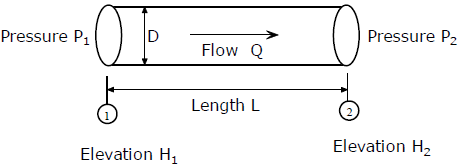
\( P_1 - P_2 = f \displaystyle\frac{L}{D} \displaystyle\frac{\rho v^2}{2} \)
Reynolds Number
One of the most important parameters in pipe flow is the dimensionless Reynolds number.
It is used to characterize the flow regime in a pipe, such as laminar, turbulent, or transitional flow.
\(\ Re = \displaystyle\frac{vD\rho}{\mu} \)
\(v\) = average gas velocity in the pipe, m/s, ft/s
\(\small D\) = internal pipe diameter, mm, in
\(\rho\) = density, kg/m³, lb/ft³
\(\mu\) = dynamic viscosity, kg/m·s, lb/ft·s
In gas pipeline hydraulics, the following form of the Reynolds number equation is often more practical:
USCS Unit System:
\(\ Re = 0.0004778 \left (\displaystyle\frac{P_b}{T_b}\right )\left (\displaystyle\frac{GQ}{\mu D}\right ) \)
\(P_b\) = base (ambient) pressure, psia
\(T_b\) = base (ambient) temperature, R (460 + °F)
\(G\) = specific gravity of the gas (air = 1)
\(Q\) = gas flow rate, standard ft³/day (SCFD)
\(\small D\) = internal pipe diameter, in
\(\mu\) = dynamic viscosity, lb/ft·s
SI Unit System:
\(\ Re = 0.5134 \left (\displaystyle\frac{P_b}{T_b}\right )\left (\displaystyle\frac{GQ}{\mu D}\right ) \)
\(P_b\) = base (ambient) pressure, kPa
\(T_b\) = base (ambient) temperature, K (273 + °C)
\(G\) = specific gravity of the gas (air = 1)
\(Q\) = gas flow rate, standard m³/day (at standard conditions)
\(\small D\) = internal pipe diameter, mm
\(\mu\) = dynamic viscosity, Poise
Modified Colebrook & General Gas Flow Equation
The Modified Colebrook–White equation has been used for many years in both liquid and gas flow applications.
\(\displaystyle\frac{1}{\sqrt{f}}=-2 \log_{10}\left (\displaystyle\frac{e}{3.7D}+\displaystyle\frac{2.825}{Re\sqrt{f}} \right )\)
f = friction factor, dimensionless
D = internal pipe diameter, mm, in
e = pipe roughness, in, mm
Re = Reynolds number, dimensionless
General Flow Equation
USCS unit system
\(Q=77.54\displaystyle\left ( \displaystyle\frac{T_{b}}{P_{b}} \right )
\left [ \displaystyle\frac{P_{1}^{2}-P_{2}^{2}}{GT_fLZf} \right ]^{0.5}D^{2.5}\)
SI unit system
\(Q=1.1494\times10^{-3}\displaystyle\left ( \displaystyle\frac{T_{b}}{P_{b}} \right )
\left [ \displaystyle\frac{P_{1}^{2}-P_{2}^{2}}{GT_fLZf} \right ]^{0.5}D^{2.5}\)
\(\small Q\) : gas flow rate, standard ft
3/day, m
3/day
\(\small L\) : pipe length, mi, km
\(\small D\) : internal diameter, in, mm
\(\small P_1\) : inlet pressure, psia, kPa (absolute pressure)
\(\small P_2\) : outlet pressure, psia, kPa (absolute pressure)
\(\small P_b\) : base (ambient) pressure, psia, kPa (typically 14.7 psia, 101.3 kPa)
\(\small T_b\) : base (ambient) temperature, R, K (typically 60+460 = 540 R, 273.16+15 = 288.16 K)
\(\small T_f\) : average gas temperature, R, K
\(\small G\) : gas specific gravity (air = 1.0),
\(\small G = \rho_{gas}/\rho_{air}\)
\(\small Z\) : gas compressibility factor
\(\small f\) : friction factor, dimensionless
Effect of Pipe Elevation (Uphill / Downhill Flow)
USCS unit system
\(Q=77.54\displaystyle\left ( \displaystyle\frac{T_{b}}{P_{b}} \right )
\left [ \displaystyle\frac{P_{1}^{2}-e^{s}P_{2}^{2}}{GT_fL_eZf} \right ]^{0.5}D^{2.5}\)
SI unit system
\(Q=1.1494\times10^{-3}\displaystyle\left ( \displaystyle\frac{T_{b}}{P_{b}} \right )
\left [ \displaystyle\frac{P_{1}^{2}-e^{s}P_{2}^{2}}{GT_fL_eZf} \right ]^{0.5}D^{2.5}\)
\(\small L_e\) : equivalent pipe length, mi, km
Relationship between \(\small L_e\) and \(\small e^{s}\)
\(L_e=\displaystyle\frac{L \left( e^{s}-1 \right )}{s}\)
s Value
USCS unit system
\(s=0.0375\,G\displaystyle\frac{H_2-H_1}{T_fZ}\)
SI unit system
\(s=0.0684\,G\displaystyle\frac{H_2-H_1}{T_fZ}\)
\(\small H_1\), \(\small H_2\) : pipe elevation, m, ft